Models
In-House vs RPO: Which Model Drives Better Results?
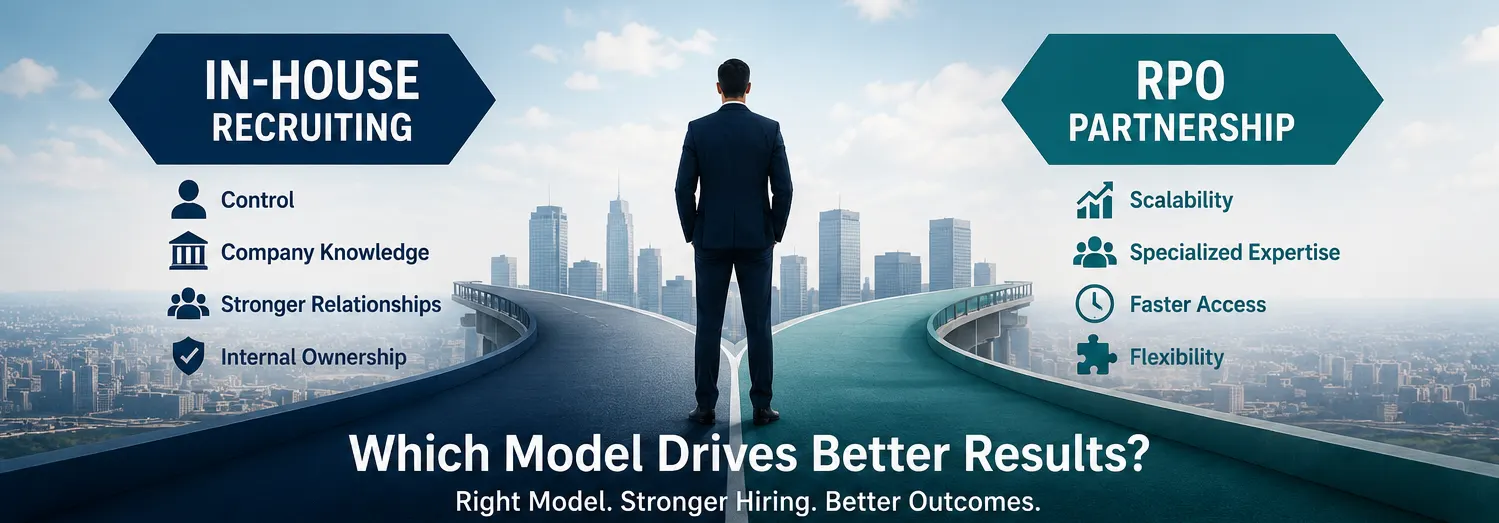
The real question is which model fits the way your business needs to hire.
Every growing company eventually faces the same challenge.
Hiring increases. Recruiters get busier. Open positions start competing for attention. Sourcing becomes harder. And suddenly, the recruiting team that worked perfectly six months ago is struggling to keep up.
At that point, leadership has a decision to make: do we build a larger internal recruiting team, or bring in an RPO partner?
There isn’t a universal answer.
In-house recruiting offers control, cultural alignment, and deep internal knowledge. RPO offers flexibility, additional capacity, specialized expertise, and the ability to scale recruiting without necessarily expanding internal headcount at the same pace.
And sometimes, the best answer isn’t either-or. It’s both.
What Is In-House Recruiting?
In-house recruiting means your organization manages recruitment internally. Your recruiters are employees of the company and work directly within its organizational structure.
They typically manage responsibilities such as:
- Sourcing candidates
- Screening applicants
- Managing interviews
- Working with hiring managers
- Coordinating offers
- Managing candidate pipelines
- Supporting employer branding
- Maintaining recruiting processes
For companies with predictable hiring needs and an established talent acquisition function, this model can work extremely well.
The recruiting team becomes deeply familiar with the organization. They know the culture. They understand the leadership team. They know which candidates tend to succeed. They learn the company’s hiring preferences over time.
That institutional knowledge is valuable. But it also comes with a cost: internal recruiting capacity can be difficult to scale quickly.
What Is RPO?
RPO stands for Recruitment Process Outsourcing.
Instead of handling some or all recruiting activities internally, a company partners with an external provider that takes responsibility for defined parts of the recruitment process.
Depending on the arrangement, an RPO partner might support:
- Candidate sourcing
- Talent research
- Market mapping
- Recruitment operations
- Screening
- Outreach
- Candidate pipeline development
- Recruiting coordination
- Recruitment technology
- Reporting and analytics
The scope can be broad or highly focused. An organization doesn’t necessarily need to outsource its entire recruiting function. It can outsource the part creating the bottleneck.
That’s an important distinction.
The Real Difference: Control vs Capacity
The simplest way to understand the difference is this: in-house recruiting emphasizes control, ownership and internal knowledge. RPO emphasizes capacity, flexibility and specialized support.
Neither is automatically better. The right choice depends on what problem you’re trying to solve.
If the problem is “We need recruiters who deeply understand our organization,” an in-house team may have the advantage.
If the problem is “Our recruiters understand the business, but they don’t have enough sourcing capacity,” RPO may be the better answer.
Where In-House Recruiting Has the Advantage
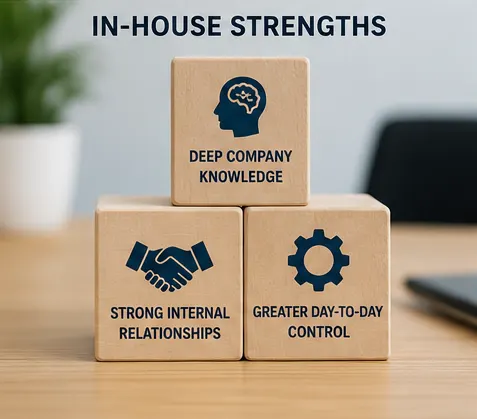
1. Deep company knowledge
Internal recruiters live inside the organization. They understand:
- Leadership styles
- Team dynamics
- Company culture
- Internal processes
- Hiring priorities
- Employer brand
- Long-term workforce plans
That knowledge can make candidate conversations more authentic. An internal recruiter can answer questions about the company from firsthand experience.
2. Strong internal relationships
Recruiting doesn’t happen in isolation. Recruiters work closely with hiring managers, HR, executives, finance teams, and leadership.
An internal team can build those relationships over time. They understand how different leaders make hiring decisions and what each department needs. That can make collaboration easier.
3. Greater day-to-day control
Some organizations want recruiting decisions to remain completely internal. They want direct control over:
- Processes
- Candidate communication
- Technology
- Data
- Employer branding
- Hiring priorities
- Recruiting strategy
For these organizations, keeping recruitment in-house may make sense.
Where In-House Recruiting Can Struggle
The biggest weakness isn’t necessarily quality. It’s scalability.
Imagine a recruiting team of five people. Then the company suddenly opens 40 positions. Hiring managers want candidates immediately. The recruiting team is now responsible for significantly more sourcing, screening, coordination, and communication.
What happens? Something usually gives. Either speed decreases, quality decreases, recruiters work longer hours, or the company hires additional recruiters.
And hiring more internal recruiters takes time. That creates a problem when hiring demand changes quickly.
Where RPO Has the Advantage
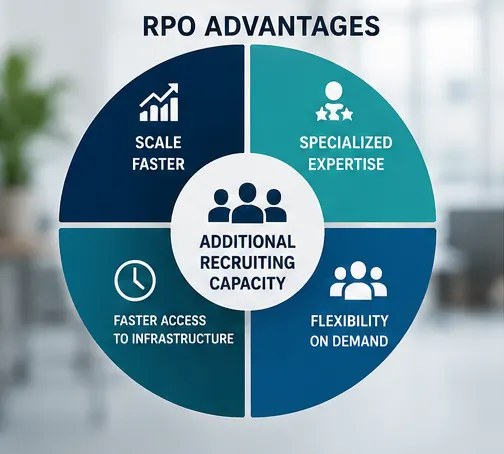
1. Recruiting capacity can scale faster
RPO can give organizations access to additional recruiting capacity without requiring every additional recruiter to become a permanent internal employee.
That can be especially useful during:
- Rapid growth
- New market expansion
- Hiring spikes
- New product launches
- Seasonal recruitment
- Large project hiring
- Difficult sourcing campaigns
Instead of permanently increasing the size of the internal team for a temporary hiring surge, organizations can add external capacity when they need it.
2. Specialized expertise
A strong RPO partner may bring experience across multiple organizations, industries, talent markets, and recruiting environments. That external perspective can be valuable when an internal team is struggling with a difficult search.
For example, an RPO team may be able to provide additional expertise in:
- Technical sourcing
- Executive research
- Market mapping
- Passive candidate engagement
- High-volume recruiting
- Talent pipeline development
The organization gains access to expertise without having to build every capability internally.
3. Faster access to recruiting infrastructure
Building a recruiting operation requires more than hiring recruiters. You also need:
- Sourcing platforms
- Databases
- ATS / CRM systems
- Research processes
- Outreach infrastructure
- Reporting
- Recruitment workflows
An experienced RPO provider may already have many of these systems and processes in place. That can shorten the time required to increase recruiting capacity.
Where RPO Can Struggle
RPO isn’t automatically the perfect solution. There are potential challenges.
Less immediate cultural familiarity
An external team needs time to understand the organization, its people, and its hiring philosophy.
Integration matters
An RPO partner needs to work closely with internal recruiters and hiring managers. Poor communication can create friction.
Not every provider is the same
The quality of an RPO engagement depends heavily on the partner, operating model, communication, and clearly defined responsibilities.
Over-outsourcing can create problems
If an organization gives away too much of the candidate relationship or employer brand without proper oversight, it can weaken the connection between candidates and the company.
That’s why the structure of the partnership matters.
The Cost Question: Which One Is Cheaper?
This is where the comparison gets interesting.
It’s tempting to compare an internal recruiter’s salary against an RPO monthly fee. But that’s not a complete comparison.
The true cost of in-house recruiting can include:
- Salaries
- Benefits
- Recruiting technology
- Sourcing platforms
- Training
- Management
- Recruitment operations
- Infrastructure
- Hiring and onboarding
- Periods of underutilization
RPO costs can include:
- Service fees
- Implementation
- Technology
- Management
- Scope-based costs
The correct comparison is therefore total recruiting cost, recruiting output, quality and scalability — not simply recruiter salary versus RPO fee.
A cheaper recruiting model isn’t necessarily better if it produces slower hiring or weaker candidates.
Speed: Who Wins?
It depends.
For a normal, predictable hiring environment, an experienced internal recruiting team may move extremely quickly. But when hiring volume suddenly increases, RPO can provide additional capacity without waiting for a lengthy internal hiring process.
Consider two scenarios.
Scenario A: stable hiring
A company consistently hires 5–10 people every month. Its internal recruiting team is experienced and has enough capacity. In-house may be the natural choice.
Scenario B: sudden hiring expansion
A company needs to hire 50 people over the next few months. The internal team doesn’t have enough sourcing capacity. RPO or additional external support may make more sense.
The answer changes because the problem changes.
Quality: In-House vs RPO
Quality isn’t determined by the label on the recruiting model. It’s determined by the process and people behind it.
An excellent internal recruiting team can outperform a weak RPO provider. An excellent RPO team can outperform an overstretched internal recruiting team.
The key factors are:
- Candidate qualification
- Sourcing strategy
- Market knowledge
- Recruiter expertise
- Hiring manager collaboration
- Candidate experience
- Data quality
- Process consistency
The real question is: which model gives your organization the strongest recruiting capability for the roles you’re hiring?
Flexibility: Where RPO Can Pull Ahead
This is one of the clearest advantages of RPO. Internal headcount is relatively fixed. Hiring needs aren’t.
A company might need 10 recruiters today, five next year, and 15 during a major expansion.
An RPO model can potentially adapt more easily to these changes. That makes it particularly attractive for organizations with variable hiring demand.
The Hybrid Model: Why Choose One?
Here’s where the conversation becomes more interesting. You don’t necessarily have to choose.
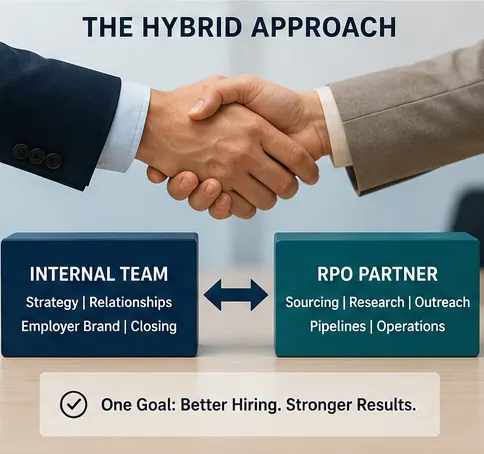
Many organizations can benefit from a hybrid recruiting model.
The internal team handles:
- Hiring strategy
- Hiring manager relationships
- Employer branding
- Candidate closing
- Final selection
- Organizational alignment
The RPO team supports:
- Sourcing
- Talent research
- Market mapping
- Candidate identification
- Outreach
- Pipeline development
- Recruitment operations
This creates a division of responsibilities: the internal team keeps strategic ownership, and the RPO team provides additional recruiting horsepower.
And for many organizations, that can be the sweet spot.
When Should You Consider RPO?
RPO becomes particularly interesting when you recognize one or more of these situations:
Your recruiters are overloaded
They’re spending too much time sourcing and not enough time interviewing, advising, and closing.
Hiring volume is unpredictable
You need additional recruiting capacity sometimes—but not necessarily permanently.
Certain roles are difficult to fill
Your internal team needs specialized sourcing support.
Your pipeline is too thin
You need additional talent research and market mapping.
Your recruiting operation isn’t scalable
Every increase in hiring requires another internal hire.
You want to expand into new talent markets
External expertise can accelerate market research and candidate discovery.
Your recruiting team needs operational support
Your recruiters have the skills but are losing time to administrative work.
In these situations, RPO isn’t necessarily replacing your recruiting team. It can extend it.
When Should You Stay In-House?
RPO isn’t right for every organization. An in-house model may make more sense when:
- Hiring volume is stable
- Your recruiting team has sufficient capacity
- Roles are relatively easy to source
- Deep internal knowledge is critical
- Your organization wants complete recruiting ownership
- Your internal processes are already highly effective
If your internal team is delivering excellent results and has plenty of capacity, outsourcing simply because RPO is popular doesn’t make sense.
Don’t outsource a problem you don’t have.
A Simple Decision Framework
Before choosing a model, ask five questions.
- How predictable is our hiring demand? Stable demand may favor internal recruiting; variable demand may favor RPO or hybrid support.
- Where is our biggest recruiting bottleneck? Sourcing, screening, candidate engagement or recruitment operations — knowing the bottleneck tells you what kind of support you actually need.
- How specialized are our roles? Highly specialized roles may benefit from external sourcing expertise.
- How quickly do we need to scale? If you need additional capacity immediately, RPO can be faster than building internal headcount.
- What should remain strategic and internal? Not everything needs to be outsourced. Determine which activities require deep organizational ownership and which can be supported externally.
The Better Question Isn’t “In-House or RPO?”
It’s: “What should our internal team own, and where would additional expertise or capacity create the greatest impact?”
That reframes the entire decision.
You don’t have to outsource your recruiting function. You don’t have to build everything internally. You can design the recruiting operation around the work that creates the most value.
For one company, that may mean a completely internal team. For another, it may mean a full RPO partnership. For a growing staffing agency or company with fluctuating hiring needs, it may mean a hybrid model.
Final Thoughts
In-house recruiting and RPO aren’t competing philosophies. They’re different ways of building recruiting capacity.
In-house gives you proximity. RPO can give you flexibility. In-house gives you deep organizational knowledge. RPO can give you additional scale and specialized expertise. And a hybrid model can combine the strengths of both.
The best choice isn’t the model that sounds better on paper. It’s the model that fits your hiring volume, talent market, internal capabilities, growth plans, and operational needs.
Before deciding, look beyond the price tag. Look at capacity. Look at speed. Look at quality. Look at scalability. And most importantly, look at whether your recruiting model is helping your organization move forward—or holding it back.
Because the goal isn’t to choose between in-house and RPO. The goal is to build a recruiting function that consistently delivers the talent your business needs.
Key Takeaways
- In-house isn’t automatically better. It works extremely well when hiring demand is stable and internal capacity is strong.
- RPO isn’t simply outsourcing. A well-designed RPO model can add capacity, expertise, and scalability.
- Cost should never be the only comparison. Evaluate total recruiting cost alongside speed, quality, and outcomes.
- RPO is particularly useful when demand fluctuates. You can add recruiting capacity without necessarily building permanent internal headcount at the same pace.
- Specialized searches can benefit from external expertise. Additional sourcing knowledge can open talent markets an internal team may struggle to reach.
- Hybrid models deserve serious consideration. Internal teams can retain strategic ownership while external teams provide sourcing and operational capacity.
- Start with the bottleneck. Don’t outsource everything. Identify exactly where your recruiting operation needs support.
- The best model is the one that fits your business. There is no universal winner between in-house and RPO.