Market
US Staffing Industry Trends You Can’t Ignore in 2026
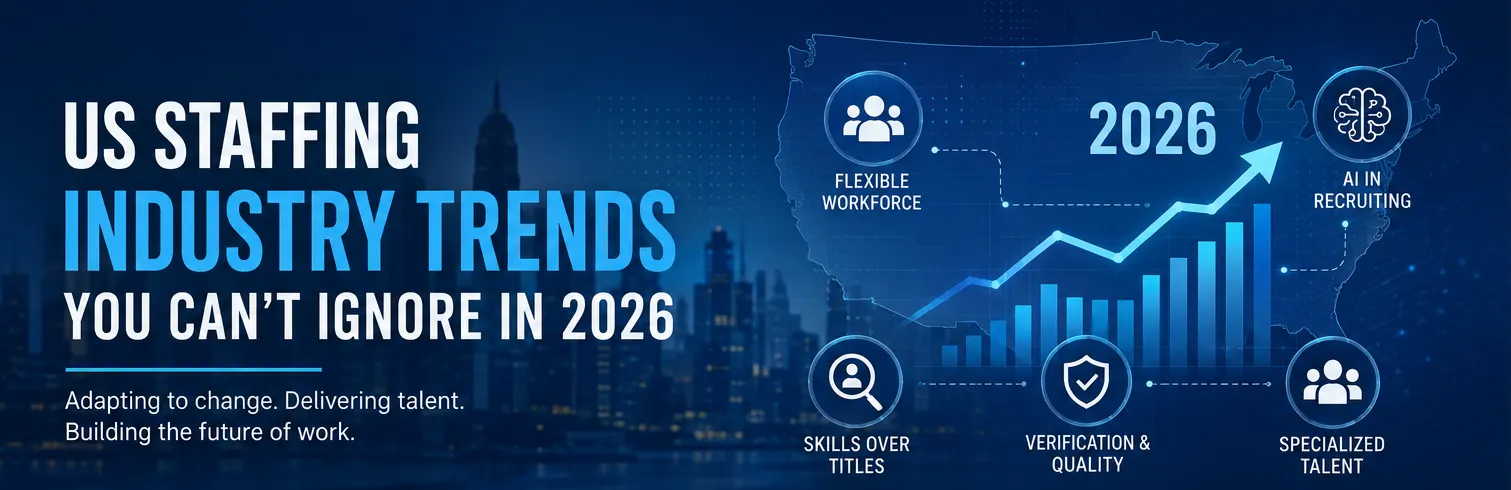
The U.S. staffing industry is entering 2026 with a very different playbook.
The market isn’t simply “hot” or “cold.”
Hiring has become more selective. Employers are balancing growth with cost control. AI is changing how work gets done and how companies evaluate talent. Contract hiring is becoming an increasingly important lever for workforce flexibility. At the same time, demand for specialized skills remains strong in areas where qualified talent is difficult to find.
For staffing firms, that creates both pressure and opportunity.
The agencies that continue using yesterday’s recruiting model may find it increasingly difficult to compete. The firms that understand where the market is moving can position themselves as something more valuable than a source of resumes. They can become workforce advisors.
Here are the 2026 trends staffing leaders should be watching closely.
1. Hiring Is Slower, But That Doesn’t Mean Demand Has Disappeared
One of the clearest signals in the 2026 labor market is a more cautious hiring environment.
Recent U.S. employment data shows a labor market that has cooled considerably compared with the rapid hiring periods of previous years. July 2026 payrolls declined, while unemployment remained relatively low, creating an unusual combination of subdued hiring and limited labor-market distress. (Business Insider)
For staffing firms, this distinction matters. Companies may still have critical positions to fill. They’re simply becoming more selective about when, where, and how they hire.
That means staffing agencies should expect more conversations like: “We need the person, but we’re not ready to make a permanent commitment.” And that creates an opening for flexible workforce solutions.
What staffing firms should do
Instead of positioning around “We can send you candidates,” position around “We can help you access the talent you need while giving you flexibility around workforce commitments.”
That’s a much stronger value proposition in a cautious market.
2. Contract and Flexible Talent Are Becoming More Strategic
Contract staffing isn’t just a backup plan for companies that can’t find permanent employees. It’s increasingly becoming part of workforce strategy.
Robert Half’s 2026 hiring research found that 56% of surveyed company leaders expected to increase their use of contract talent in the second half of the year, while 66% planned to increase permanent headcount. (Robert Half)
That combination is important. It suggests companies aren’t choosing between permanent and contingent workers. They’re using both.
Permanent employees can provide long-term organizational stability. Contract professionals can provide flexibility, specialized expertise, and additional capacity when business needs change.
What this means for staffing agencies
Agencies that specialize exclusively in permanent placement may be missing part of the opportunity.
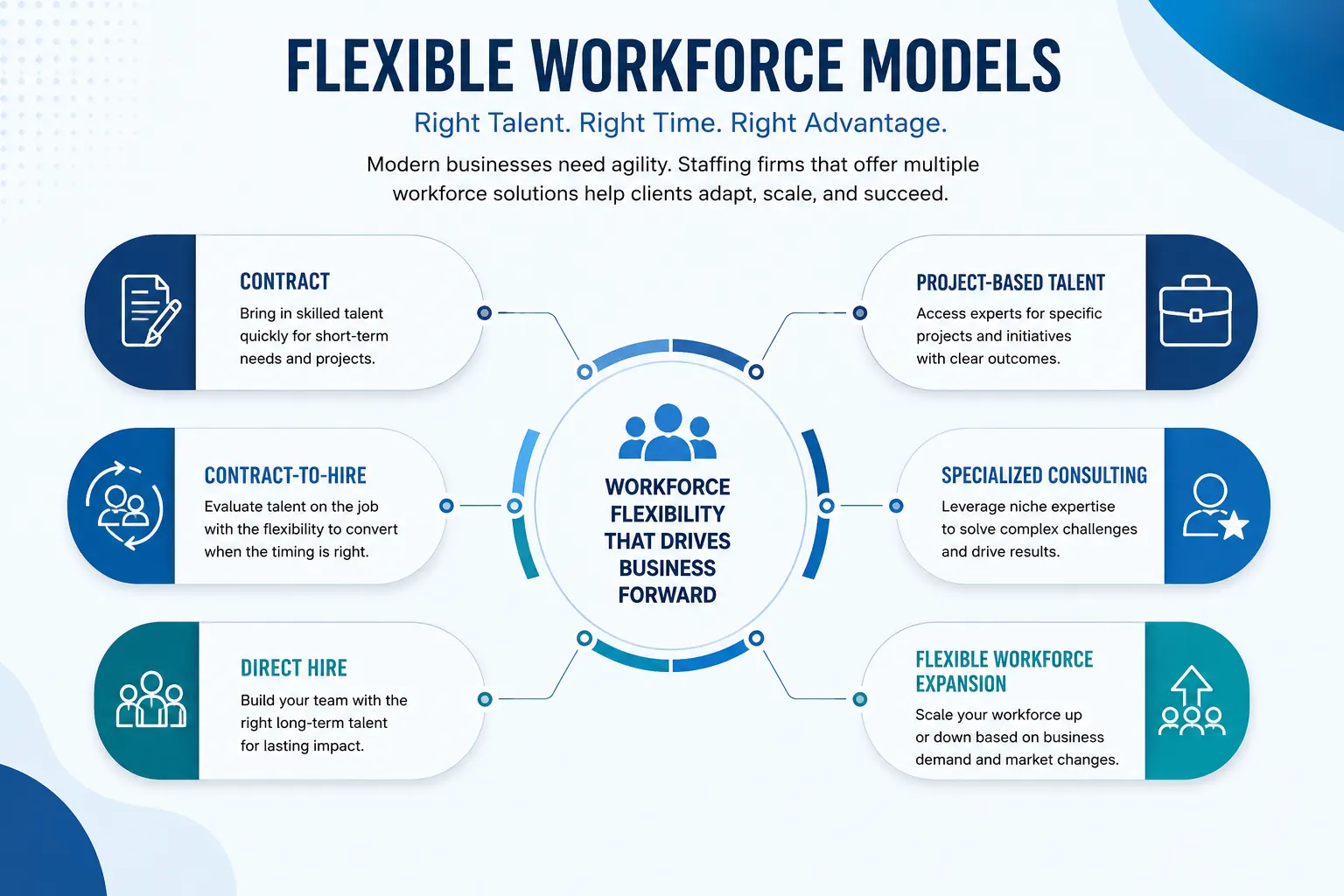
Staffing firms should consider whether they can support clients across multiple workforce models, including:
- Contract
- Contract-to-hire
- Direct hire
- Project-based talent
- Specialized consulting
- Flexible workforce expansion
The more workforce options an agency can intelligently offer, the more valuable it becomes to clients.
3. Skills Are Becoming More Important Than Traditional Job Titles
The old recruiting model often starts with a title: find a Senior Software Engineer, find a Financial Analyst, find a Marketing Director.
But the labor market is becoming increasingly skills-oriented.
The American Staffing Association highlighted skills-based and outcome-driven hiring as a major force shaping staffing in 2026, with employers placing less emphasis on traditional resumes and job titles. (American Staffing Association)
This shift makes sense. Job titles aren’t standardized. Two people with the same title can have completely different responsibilities. And someone without the “perfect” title may possess exactly the skills a client needs.
The new question
Instead of asking “Who has held this exact title?” staffing firms should increasingly ask “Who has demonstrated the capabilities required to succeed in this role?”
That opens up a much larger talent market.
4. AI Is Reshaping Both Jobs and Recruiting
AI isn’t simply another recruiting technology. It’s changing the underlying labor market.
Companies are asking:
- Which tasks can AI automate?
- Which skills will become more valuable?
- Which roles will evolve?
- What should we hire for?
- What capabilities will our workforce need next year?
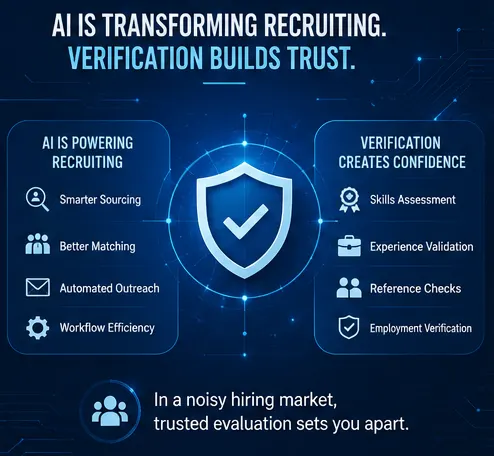
At the same time, AI is affecting recruiting itself. Staffing professionals are increasingly using AI for sourcing, research, matching, outreach, and workflow automation.
But there is an important complication.
AI can increase the volume of applications and make it harder to distinguish genuine qualifications from automated or AI-generated submissions. Robert Half reports that 65% of surveyed business leaders experienced hiring challenges related to AI-generated applications, while 67% said they were more likely to seek staffing-firm support. (Robert Half)
That could create a major opportunity for staffing agencies. When hiring gets noisier, trusted evaluation becomes more valuable.
5. Verification Is Becoming a Bigger Part of Recruiting
More technology doesn’t necessarily mean easier hiring. In some ways, it creates a new problem: how do you know what you’re looking at is real?
AI can help candidates create polished resumes, applications, portfolios, and written responses. That makes surface-level screening less reliable.
Staffing firms may increasingly differentiate themselves through stronger candidate validation. That can include:
- Structured screening
- Skills verification
- Technical assessments
- Reference checks
- Employment verification
- Deeper candidate conversations
- Portfolio evaluation
- Experience validation
The competitive advantage isn’t simply finding someone who looks qualified. It’s being able to confidently tell a client: “We’ve evaluated this person, and here’s why they actually fit.”
6. Specialized Talent Is Becoming More Valuable
Not every part of the labor market is moving at the same speed. Some skill areas continue to experience strong demand.
Industry experts cited by the American Staffing Association point to continued demand for specialized talent in areas including AI, cloud, cybersecurity, and digital platforms such as ServiceNow. (American Staffing Association)
This creates an important strategic question for staffing agencies: should we recruit for everything or become exceptional at something?
Specialization can create a significant advantage. An agency that deeply understands one talent market can develop:
- Better candidate networks
- Stronger market knowledge
- Faster sourcing
- Better candidate qualification
- More credible client conversations
- Stronger employer relationships
In a competitive staffing market, depth can beat breadth.
7. Healthcare and Human-Centered Roles Remain Resilient
While AI is transforming many parts of the workforce, some categories remain heavily dependent on human interaction. Healthcare is one of the clearest examples.
The Bureau of Labor Statistics’ latest projections indicate that healthcare and social assistance will account for a substantial share of U.S. employment growth through 2035, driven largely by an aging population. (Axios)
This highlights an important point for staffing leaders: the future of work won’t be shaped by technology alone. Demographics matter. Population aging matters. Skills shortages matter. Care delivery matters.
Agencies that understand these structural forces can identify opportunities well before they become obvious to everyone else.
8. Employers Are Becoming More Comfortable With Flexible Workforce Models
The traditional workforce question was often “Should we hire an employee?” The modern question is becoming “What type of workforce do we need for this stage of the business?”
That could involve:
- Full-time employees
- Contractors
- Interim professionals
- Project teams
- Fractional specialists
- Contract-to-hire talent
The reason is simple. Businesses face more uncertainty around demand, technology, costs, and organizational design. A flexible workforce allows them to respond without making every staffing decision permanent.
For staffing agencies, this expands the opportunity from placement provider to workforce partner.
9. Clients Will Expect More Strategic Value From Staffing Firms
The days when a client simply sends a job description and waits for resumes are fading.
Clients increasingly need staffing partners who can answer questions such as: Is this talent available? Is the compensation competitive? Are our requirements realistic? Where should we search? Should this role be permanent or contract? How long will this search realistically take? Which skills should we prioritize?
This means market intelligence is becoming part of the staffing product.
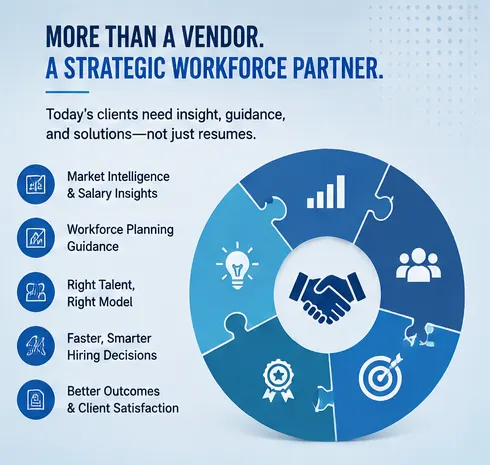
A staffing firm that can provide data, context, and recommendations has a stronger position than one that simply forwards candidate profiles.
10. Speed Still Matters but Accuracy Matters More
Fast recruiting has always been valuable. But 2026 is making the distinction between fast and usefully fast more important.
Sending 20 irrelevant candidates within 24 hours isn’t necessarily better than sending four highly qualified candidates in 48 hours.
Clients don’t need activity. They need progress.
That means staffing firms should measure more than how many resumes they sent. They should also examine:
- Submission-to-interview ratio
- Interview-to-offer ratio
- Offer acceptance
- Time-to-fill
- Candidate retention
- Client satisfaction
- Quality of hire
The goal is not maximum candidate volume. It’s maximum useful movement through the hiring process.
11. Staffing Firms Are Becoming More Technology-Enabled
Technology is no longer something staffing firms can treat as an optional productivity upgrade.
Recruiting platforms, AI tools, automation, ATS systems, CRM platforms, sourcing technologies, and analytics are becoming part of the operating infrastructure.
But there is a trap. Buying more software doesn’t automatically make an agency more competitive. The real advantage comes from how well the systems work together.
A strong staffing operation should know:
- Where candidate data lives
- How prospects enter the pipeline
- How candidates are qualified
- How outreach is managed
- Where follow-ups happen
- How performance is measured
- Which tasks should be automated
Technology should simplify the operation, not create another layer of complexity.
12. The Staffing Firms That Adapt Will Have the Advantage
Perhaps the biggest trend of 2026 isn’t AI. It isn’t contract staffing. It isn’t skills-based hiring. It’s adaptability.
The market is moving quickly enough that staffing firms can’t build their strategy around one permanent assumption. They need to be able to respond when:
- Hiring demand changes
- Client requirements shift
- New technologies emerge
- Candidate expectations evolve
- Skills become scarce
- Economic conditions change
The strongest agencies won’t necessarily predict every change correctly. They’ll be able to respond faster when the change happens.
What These Trends Mean for Staffing Agencies
Taken individually, these trends are important. Together, they point toward a larger transformation.
The staffing agency of the future is likely to be more specialized, more technology-enabled, more data-driven, more flexible, more consultative, and increasingly focused on helping clients solve workforce problems rather than simply filling vacancies.
That means staffing leaders should be asking themselves: Are we selling candidates or solving talent problems? Are we measuring activity or outcomes? Are we using technology to create leverage or just adding more tools? Are we building talent communities or starting from scratch for every search? Do our recruiters understand the markets they serve?
Those questions may matter more than any single staffing trend.
A 2026 Playbook for Staffing Leaders
The trends are important. But knowing what to do about them is even more important.
- Build stronger talent intelligence. Know where your candidates are, what skills they have, and how the market is changing.
- Expand workforce options. Be prepared to support clients with permanent, contract, and flexible talent models.
- Invest in specialization. Develop deep expertise in the industries and skill categories where your clients need help.
- Strengthen candidate verification. Make quality and authenticity part of your competitive advantage.
- Use AI strategically. Automate repetitive work, but keep human judgment at the center of candidate evaluation.
- Become more consultative. Give clients market insight, not just resumes.
- Measure outcomes. Focus on placements, retention, quality, and client satisfaction—not just sourcing volume.
Final Thoughts
The U.S. staffing industry isn’t disappearing. It’s becoming more sophisticated.
Companies still need talent. Candidates still need opportunities. But the way those two groups connect is changing.
Economic uncertainty is encouraging employers to think more carefully about workforce commitments. Contract talent is becoming more strategic. Skills are becoming more important than titles. AI is changing both work and hiring. Specialized talent remains difficult to find. And clients increasingly expect staffing firms to bring insight, not just candidates. (American Staffing Association)
For staffing agencies, the message is clear: the old model of simply filling open jobs isn’t enough anymore.
The opportunity is to become faster, smarter, more specialized, and more valuable to clients.
The agencies that make that transition won’t just survive changing market conditions. They’ll be positioned to grow because of them.
Key Takeaways
- Hiring is becoming more cautious. Staffing firms need to help clients manage uncertainty without sacrificing access to talent.
- Contract talent is increasingly strategic. Flexible workforce models are becoming an important part of workforce planning.
- Skills are overtaking titles. Recruiters need to evaluate capabilities, not just keywords.
- AI is creating both opportunity and complexity. It can improve recruiting productivity while also making candidate evaluation more challenging.
- Candidate verification matters more. Staffing firms can differentiate themselves by providing confidence in candidate quality.
- Specialized talent remains valuable. Deep expertise can give staffing agencies an advantage in competitive markets.
- Human-centered industries remain resilient. Demographic forces, particularly in healthcare, will continue shaping workforce demand.
- Clients want workforce advice. Staffing firms have an opportunity to become strategic partners rather than transactional vendors.
- Speed must be paired with quality. Fast submissions mean little if they don’t lead to interviews and placements.
- Adaptability is the ultimate competitive advantage. The staffing firms that can respond quickly to market changes will be best positioned for what comes next.