Sourcing
The Future of Sourcing: AI, Automation & Human Intelligence
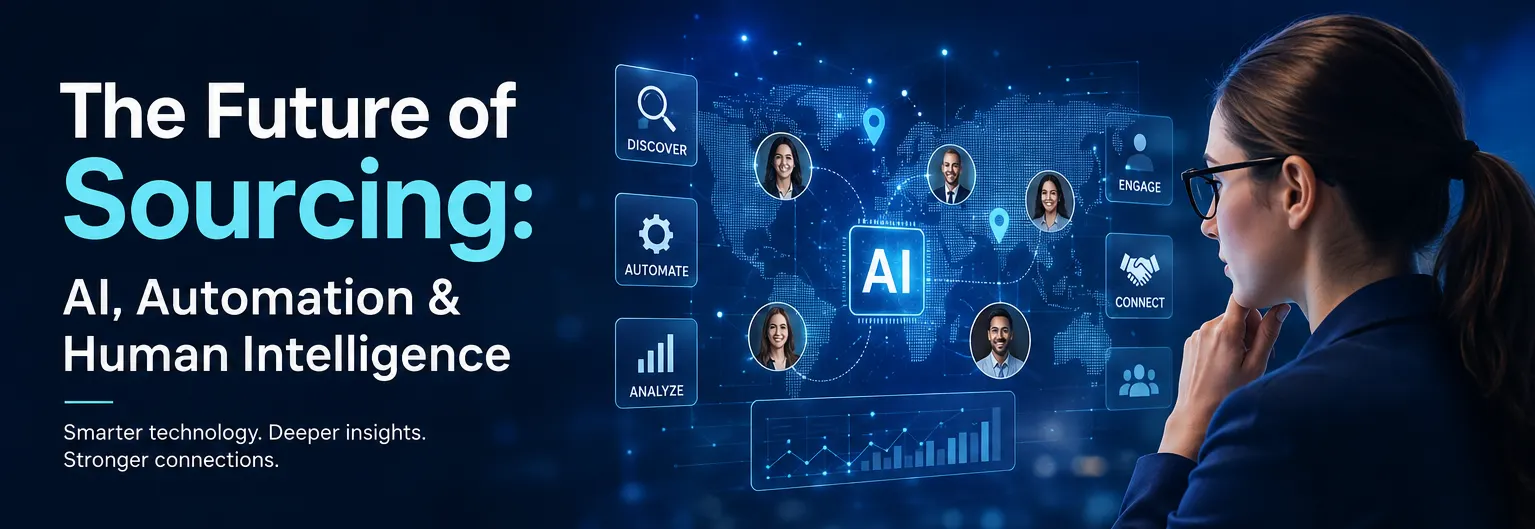
The sourcing game is changing. The recruiters who adapt first will have a serious advantage.
For years, sourcing success was measured by how quickly a recruiter could find people:
- Write a Boolean string.
- Search a database.
- Open profiles.
- Build a list.
- Send messages.
- Repeat.
That model worked when recruiting databases were smaller, candidate information was harder to access, and the biggest challenge was simply finding enough people.
That’s no longer the problem.
Today, recruiters can access enormous talent pools, sophisticated search platforms, AI-powered tools, automated workflows, and more candidate data than ever before.
The challenge has shifted.
The future of sourcing isn’t about finding more candidates. It’s about identifying the right talent signals, understanding what they mean, and knowing what to do with them.
That’s where AI, automation, and human intelligence come together.
Sourcing Is Moving From Search to Intelligence
Traditional sourcing is fundamentally a search exercise. You start with a job description and look for people who appear to match it.
But a modern sourcing strategy can go much further.
Instead of asking “Who has this job title?” recruiters can ask “Where does this kind of talent come from?”
Instead of “Who has these five skills?” they can ask “Which career paths tend to produce people with this combination of skills?”
And instead of “Who is available?” they can investigate “Who might become available and what could motivate them to move?”
That’s a major shift. Sourcing is becoming less about searching databases and more about interpreting the talent market.
1. AI Will Change How Recruiters Find Talent
AI can process information at a scale that would be unrealistic for a human recruiter to handle manually.
It can help identify patterns across:
- Skills
- Career histories
- Job changes
- Industries
- Companies
- Experience
- Professional backgrounds
- Geographic markets
This creates new possibilities for sourcing.
A recruiter could potentially use AI to identify candidates who don’t have the exact job title listed on their profile but possess the underlying experience required for the role.
That’s important because job titles are often poor proxies for capability. A “Product Manager” at one company might perform very different work from a “Product Manager” somewhere else. Likewise, someone with an unconventional title might have exactly the experience a client needs.
AI can help uncover those less obvious connections. But the recruiter still has to determine whether the connection is meaningful.
2. Skills Will Matter More Than Job Titles
One of the biggest changes ahead is the move toward skills-based sourcing.
Traditional searches often start with titles: Software Engineer, Account Executive, Marketing Director, Financial Analyst.
But titles vary dramatically between companies. Skills provide a more useful layer of understanding.
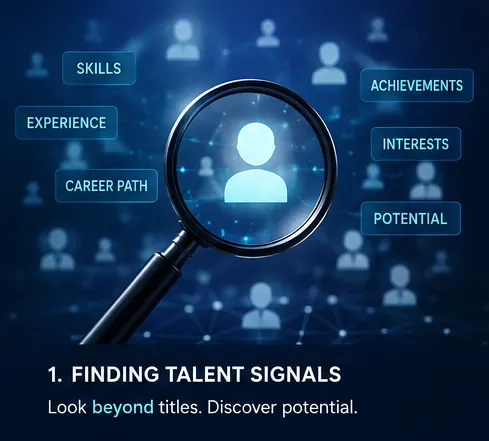
A future sourcing strategy might look at combinations such as Python + machine learning + distributed systems + technical leadership, rather than simply searching for “Senior Machine Learning Engineer.”
This opens the door to candidates who might otherwise be overlooked.
For recruiters, that means learning to think beyond the wording of a resume. The question becomes: what capabilities does this person actually have? Not simply: what does their profile call them?
3. Automation Will Take Over the Repetitive Parts of Sourcing
Recruiters spend a surprising amount of time moving information around: candidate identified, candidate added to database, contact information updated, recruiter notified, follow-up scheduled, status changed, notes recorded.
These steps are necessary, but they don’t necessarily require human creativity.
Automation can connect these activities into a workflow. For example: candidate discovered → data enriched → candidate added to CRM → outreach sequence triggered → response tracked.
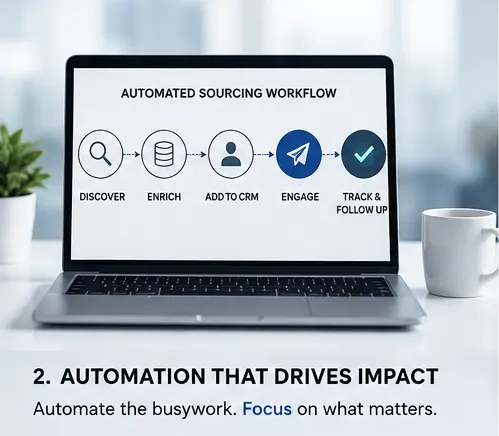
Instead of manually managing every stage, recruiters can design the process once and allow technology to execute the repetitive components.
That changes the recruiter’s role. They spend less time operating the system and more time interpreting what the system produces.
4. Talent Pools Will Become Dynamic
A traditional candidate database is often treated like a storage system. A modern talent intelligence system can be much more dynamic.
Candidate information changes. People get promoted. Skills evolve. Companies restructure. Employees change industries. Professionals become more open to new opportunities.
Someone who wasn’t relevant six months ago could suddenly become an ideal candidate.
This means sourcing databases shouldn’t simply answer “Who did we find?” They should increasingly help answer “Who has become relevant?”
That’s a fundamentally different way of thinking about talent pools. The database becomes a living source of intelligence, rather than a collection of old resumes.
5. Recruiters Will Start Looking for Talent Signals
The most valuable sourcing insights may not always appear in a job title. They can exist in subtle changes across someone’s professional journey. For example:
- A recent promotion
- A long tenure reaching a natural transition point
- A new leadership responsibility
- A move into a new specialization
- A company experiencing rapid growth
- A significant organizational change
- A newly acquired skill
- A change in location
- A shift in professional focus
None of these automatically mean someone wants to change jobs. But they can provide context for a sourcing conversation.
AI can help surface these patterns. Human recruiters decide whether they’re actually meaningful.
6. The Best Outreach Will Be Based on Context
The future of sourcing isn’t simply about sending personalized messages. It’s about understanding why the message should be sent in the first place.
There’s a major difference between “I noticed your experience and thought you’d be a great fit” and “You’ve recently moved into leading a larger engineering organization, and we’re speaking with companies looking for someone who can scale an engineering function through its next stage of growth.”
The second message has context. That’s where technology can help.
AI can accelerate research and draft communication. But human recruiters still need to decide:
- Is the opportunity relevant?
- Is the timing right?
- Is the message appropriate?
- Does the candidate’s background actually support the claim?
- Does the opportunity make sense for their career?
Personalization without understanding is just automation wearing a friendly face.
7. Human Judgment Becomes More Valuable, Not Less
This may sound counterintuitive. If AI gets better at sourcing, why would human recruiters become more important?
Because finding information and understanding information are different skills.
AI might identify a candidate as a strong match. A recruiter might discover that the candidate:
- Doesn’t want to relocate
- Is targeting a different level
- Has already spoken with the company
- Wants a different type of role
- Is committed to their current team
- Would only move for a specific opportunity
Those details can completely change the outcome.
The recruiter brings something technology doesn’t automatically possess: context.
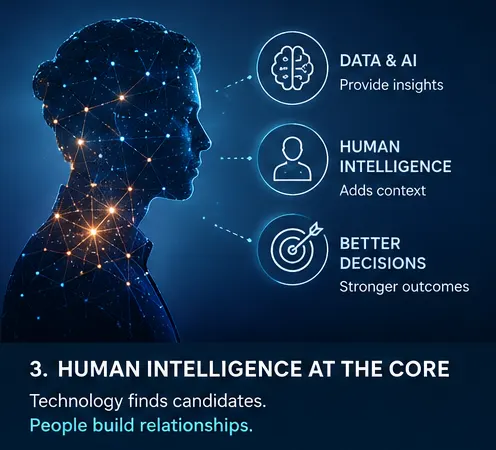
That’s why the future recruiter won’t simply be a search expert. They’ll be an interpreter of talent information.
8. Sourcing Will Become More Strategic
As repetitive searching becomes easier, recruiters can spend more time thinking about the market itself.
They might ask: Why is this role difficult to fill? Which companies have the strongest talent pool? Is the client’s compensation competitive? Are the requirements too restrictive? Which adjacent skill sets could work? Which markets should we explore? What does the candidate market look like right now?
These are strategic questions. And they’re where recruiters can create significantly more value for clients.
A recruiter who can tell a client “Your requirements are eliminating most of the available talent — if we broaden this one skill requirement, we can access a much larger qualified market” isn’t simply filling jobs. They’re providing talent-market intelligence.
9. AI Won’t Eliminate Bias Automatically
It’s tempting to assume that technology makes recruiting more objective. It doesn’t necessarily.
AI systems learn from data. And historical recruiting data can contain human biases.
If past hiring decisions favored particular backgrounds, companies, schools, career paths, or demographics, an AI system trained on that information can potentially reproduce those patterns.
That’s why human oversight remains critical. Recruiters need to question: Why did the system recommend this person? What information is influencing the recommendation? Who might be missing from the results? Are we unintentionally narrowing the talent pool?
The goal shouldn’t be to blindly trust AI. The goal should be to use AI while maintaining critical human oversight.
10. The Sourcing Team of the Future Will Look Different
The sourcing function itself may evolve. Instead of recruiters spending most of their time manually searching profiles, teams could increasingly divide responsibilities between:
- Technology — discovery, data processing, enrichment, automation, pattern recognition.
- Sourcers — research strategy, candidate evaluation, market mapping, outreach positioning.
- Recruiters — candidate conversations, qualification, relationship management, closing.
- Leadership — talent strategy, workforce planning, client advisory, and performance analysis.
The boundaries won’t always be this clean. But the direction is clear: less manual execution, more strategic thinking.
What This Means for Staffing Agencies
For staffing agencies, this shift could be especially significant.
The traditional scaling model is straightforward: more job orders → more recruiters → more sourcing capacity.
But technology introduces another possibility: better systems → greater recruiter productivity → more capacity.
That doesn’t mean agencies should eliminate recruiters. It means they can give recruiters leverage.
A sourcing team equipped with strong technology and well-designed processes can potentially research larger markets, maintain better talent pools, respond to searches faster, and spend more time engaging qualified candidates.
This can be particularly valuable when agencies are dealing with:
- Multiple simultaneous searches
- Specialized positions
- Difficult-to-find skills
- High-volume recruiting
- Competitive talent markets
- Tight client deadlines
The competitive advantage may no longer be who has the biggest recruiting team. It may be who has the smartest sourcing system.
The New Sourcing Stack
A modern sourcing operation may eventually look less like a collection of disconnected tools and more like an integrated intelligence system.
- Discover — AI-assisted search identifies potential talent.
- Understand — research tools provide context around candidates and markets.
- Enrich — contact and professional data is organized.
- Prioritize — candidates are segmented according to relevance.
- Engage — automated workflows support outreach.
- Interpret — human recruiters evaluate the response and context.
- Convert — recruiters turn promising conversations into interviews and placements.
The technology handles the scale. The recruiter handles the meaning.
What Recruiters Should Start Doing Now
You don’t need to completely rebuild your recruiting operation overnight. Start small.
Audit your manual work
Identify tasks that consume hours but require little judgment.
Experiment with AI
Use it for research, search development, writing, summarization, and workflow support.
Clean your database
Technology can’t compensate for poor candidate data.
Build reusable workflows
Document how sourcing moves from identification to outreach to qualification.
Measure productivity
Track time-to-source, response rates, submissions, interviews, and placements.
Develop AI literacy
Recruiters don’t need to become engineers. They do need to understand how to use AI effectively and evaluate its output critically.
Protect the human conversation
Don’t allow automation to replace the conversations that actually create relationships.
The Biggest Shift: From Recruiter as Searcher to Recruiter as Strategist
This is perhaps the most important transformation.
Historically, sourcing expertise often meant knowing:
- Where to search
- What Boolean strings to use
- Which databases to check
- How to find contact information
Those skills still matter. But technology is increasingly making information easier to access.
The differentiator becomes what the recruiter does with the information.
Can they recognize an unconventional candidate? Can they understand a talent market? Can they identify a hidden skill connection? Can they challenge a client’s unrealistic requirement? Can they understand why someone would move? Can they build trust? Can they turn data into a recruiting strategy?
Those capabilities will become increasingly valuable.
Final Thoughts
The future of sourcing won’t arrive as one dramatic technological breakthrough. It will happen gradually.
Search will become smarter. Databases will become more intelligent. Automation will remove repetitive work. AI will uncover patterns humans might miss. And recruiters will spend more time doing what technology struggles to replicate: understanding people.
The sourcing professionals who thrive won’t be those who resist AI. They also won’t be those who automate everything. They’ll be the ones who understand where technology creates leverage—and where human judgment creates value.
Because the future isn’t AI replacing sourcing. It’s AI-powered sourcing guided by human intelligence.
And that combination has the potential to make recruiting not only faster, but smarter.
Key Takeaways
- Sourcing is moving beyond traditional search. Recruiters will increasingly use technology to understand talent markets, not simply find profiles.
- Skills will matter more than job titles. The best candidates won’t always have the exact title written in the job description.
- Automation will handle more repetitive work. Recruiters can spend less time managing workflows and more time evaluating talent.
- Candidate databases will become dynamic. The value of a talent pool will depend on how intelligently it is maintained and updated.
- AI can identify talent signals. Recruiters can use those signals to decide when and how to engage candidates.
- Context will make outreach more effective. Personalization is only valuable when it’s based on genuine understanding.
- Human judgment remains essential. AI can identify patterns, but recruiters provide context, empathy, and decision-making.
- Sourcing will become more strategic. Recruiters will increasingly advise clients about talent availability and market conditions.
- Responsible AI matters. Human oversight is necessary to identify errors, bias, and poor recommendations.
- The future belongs to augmented recruiters. The strongest sourcing teams will combine AI, automation, data, and human expertise.